

Marine Road on Brink of Collapse as Residents Warn of Looming Disaster

Marine Road on Brink of Collapse as Residents Warn of Looming Disaster
Share

Marine Road on Brink of Collapse as Residents Warn of Looming Disaster

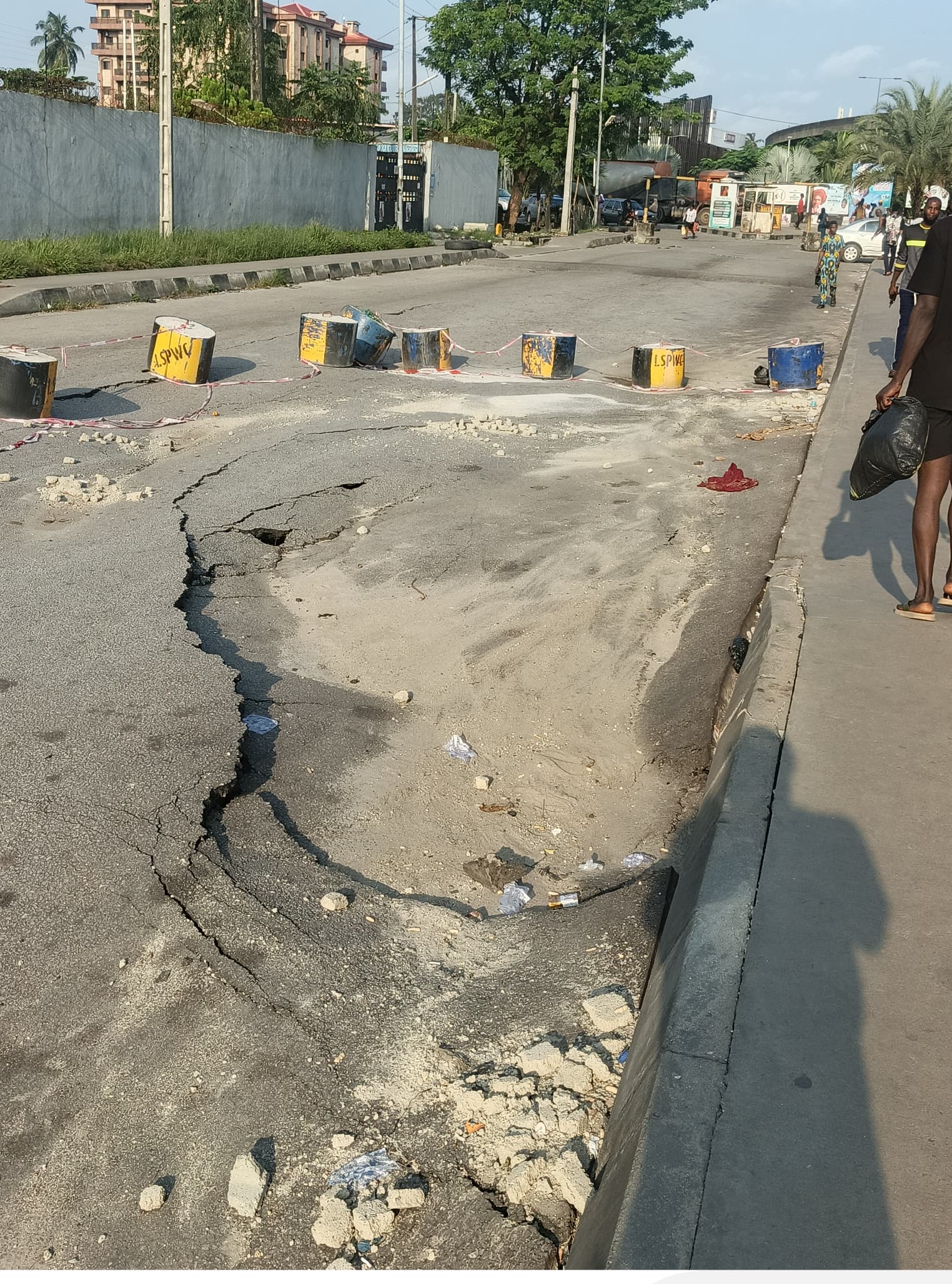
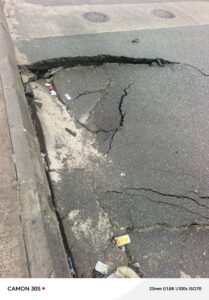
Residents, motorists, and businesses along Marine Road, off Liverpool Road in Apapa, are sounding the alarm over what they describe as an imminent catastrophe. The critical access route has developed widening cracks and deep fissures, leaving large portions of asphalt displaced and on the verge of total collapse.

A visit to the site revealed alarming damage: cracks now stretch across the full width of the carriageway, while sections have sunk dangerously, forming cavities capable of swallowing vehicles or unsuspecting pedestrians. Makeshift safety measures — concrete drums and caution tape — have been deployed by residents, but the road remains a grave hazard, especially at night.

Heavy-duty trucks and articulated vehicles, which frequently ply the corridor, are feared to be accelerating the deterioration. “This is no longer an ordinary pothole. The road is collapsing before our very eyes,” one resident lamented. Another commuter described it as “a ticking time bomb,” warning that one overloaded truck or heavy rainfall could trigger a complete cave-in.

The implications extend beyond safety. Marine Road is a vital link within Apapa, connecting residential neighborhoods, businesses, and serving as an alternative route to the Liverpool axis. Its collapse would cripple access, disrupt port operations, and worsen Apapa’s already notorious traffic gridlock.

Despite the visible danger, residents say no government agency has commenced emergency repairs. They note that the cracks widen daily, particularly after rainfall, suggesting deeper structural failure beneath the surface.
Stakeholders are calling on Apapa Local Government, the Lagos State Government, and the Ministry of Works and Infrastructure to urgently conduct a structural assessment and begin reconstruction. They stress that preventive action is far less costly than managing the aftermath of a disaster. Emergency management agencies are also urged to strengthen safety measures around the failed section to avert accidents pending permanent repairs.

For those who live and work along Marine Road, each day without intervention increases the risk of catastrophic failure. The warning signs are clear: the road is cracking apart, the surface is sinking, and danger is imminent.


Related articles

Customs Unveils 3,852 Successful Recruits, Adopts Annual Employment Exercise The Nigeria Customs Service (NCS) has announced the release of the final list of 3,852 successful candidates for its 2024/2025 recruitment exercise and unveiled plans to institutionalise annual recruitment to ensure continuous manpower renewal. Speaking at a press briefing, the Comptroller-General of Customs, Bashir Adewale Adeniyi, said the successful applicants were selected across three entry cadres, with 1,275 recruited into the Superintendent Cadre, 367 into the Inspectorate Cadre, and 2,210 into the Customs Assistant Cadre. Adeniyi said the publication of the final list marks the successful conclusion of the recruitment exercise, which commenced in December 2024. He apologised for the delay in completing the exercise, attributing it to the unprecedented number of applications received and the Service’s determination to conduct a transparent, credible and merit-driven recruitment process. According to the Customs boss, the Service received 573,680 applications for just 3,852 available positions, making the exercise one of the most competitive in the agency’s history. He explained that all applications underwent rigorous screening procedures, including computer-based examinations, verification of credentials against the National Identity database, and additional checks where inconsistencies were detected. He noted that candidates who made the final list would still undergo physical and medical examinations before receiving final approval from the Nigeria Customs Service Board. Adeniyi disclosed that the overall success rate was 0.67 per cent, meaning only one out of every 148 applicants secured a place in the exercise. Breaking down the figures, he said the Superintendent Cadre attracted 276,995 applications for 1,275 vacancies, representing one successful applicant out of every 217 candidates. The Inspectorate Cadre recorded 128,604 applications for 367 positions, making it the most competitive category with one successful candidate for every 350 applicants, while the Customs Assistant Cadre received 168,081 applications for 2,210 vacancies, translating to one successful applicant for every 76 candidates. He encouraged unsuccessful applicants not to be discouraged, stressing that many met the required qualifications but could not be accommodated because of the limited vacancies and intense competition. The Comptroller-General said the recruitment reflected the Federal Character principle, with all 36 states and the Federal Capital Territory represented. Each state was allocated 105 slots, comprising 35 positions in the Superintendent Cadre, 10 in the Inspectorate Cadre and 60 in the Customs Assistant Cadre, while the FCT received 72 slots under the approved allocation formula. On gender representation, Adeniyi revealed that women accounted for 839 successful candidates, representing 21.8 per cent of the total intake, slightly higher than their 21.2 per cent share of the total applications received. He added that female applicants recorded a marginally higher success rate than their male counterparts, particularly in the Inspectorate and Customs Assistant cadres, reaffirming the Service’s commitment to encouraging greater female participation in future recruitment, especially in operational and enforcement roles. According to him, the exercise also produced a youthful workforce, with a median age of 26 years and nearly three-quarters of the successful candidates below the age of 30. He said the youthful intake would strengthen the Service’s capacity to embrace modern customs administration driven by technology, data analytics and automated risk management. Adeniyi further announced that the Nigeria Customs Service would now conduct recruitment exercises annually instead of waiting several years between recruitment cycles. He disclosed that the 2026 recruitment exercise would commence later this year, expressing confidence that future recruitment would be completed within a single calendar year, from advertisement to the publication of the final list. According to him, the digital systems, screening architecture and verification processes developed during the current exercise would significantly shorten future recruitment timelines. He explained that the annual recruitment policy would enable the Service to plan its workforce more effectively, promptly replace retiring personnel and provide qualified Nigerians with predictable employment opportunities. The Comptroller-General advised successful candidates to rely only on official Nigeria Customs Service communication channels for further instructions, reiterating that recruitment into the Service remains completely free. He urged members of the public to report anyone demanding money in exchange for employment, describing such individuals as fraudsters. Congratulating the successful candidates, Adeniyi reminded them that they earned their positions through a rigorous and highly competitive process and urged them to uphold the professionalism, discipline and integrity expected of officers of the Nigeria Customs Service. He also assured unsuccessful applicants that another opportunity would be available later this year under the newly introduced annual recruitment programme.

Leave a Reply

Your email address will not be published. Required fields are marked *