
FG Approves Lagos-Ibadan Expressway Reconstruction, Expands National Road Infrastructure
FG Approves Lagos-Ibadan Expressway Reconstruction, Expands National Road Infrastructure
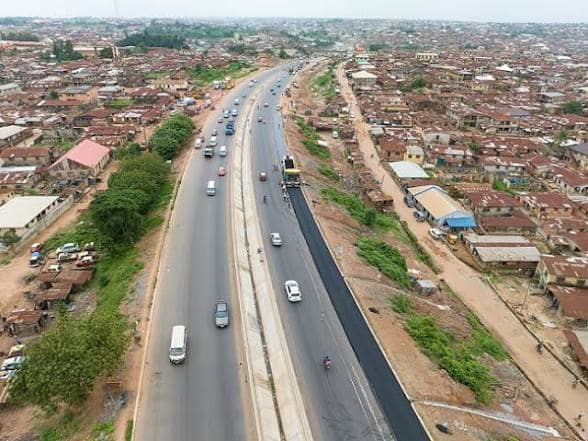
President Bola Tinubu has approved the full reconstruction of the Lagos-Ibadan Expressway following the deterioration of sections of the highway less than five years after its rehabilitation.
The Minister of Works David Umahi who made this known while speaking with journalists over the weekend, said the approval reinforces the federal government’s decision to adopt reinforced concrete pavement for major highways, arguing that the technology offers significantly greater durability than conventional asphalt.
According to the minister, the existing asphalt surface on the Lagos-Ibadan Expressway has continued to fail despite repeated maintenance efforts.
According to Umahi, “The President approved the reconstruction of the Lagos-Ibadan Road, and that justifies our insistence on using reinforced concrete pavement.”
He noted that the 135-kilometre dual carriageway, completed less than five years ago, has already shown signs of structural failure.
“We took journalists and members of the National Assembly to inspect the road. They saw the failures. It was repaired, but the damage reappeared,” he said.
Umahi explained that the highway would now be rebuilt with reinforced concrete pavement, which he said could last between 50 and 100 years with minimal maintenance.
Beyond the Lagos-Ibadan Expressway, the minister announced several new approvals aimed at accelerating the government’s infrastructure agenda.
Moreover, the Minister said Tinubu, has already approved the extension of the Fourth Legacy Highway by an additional 400 kilometres, increasing the strategic corridor from about 700 kilometres to roughly 1,100 kilometres.
The expanded route will extend into Taraba State, strengthening transport links between the North-Central and North-East while passing through several historic communities.
“The greatest story is that the president approved an additional 400 kilometres for the Fourth Legacy Road. That is unprecedented,” Umahi said.
He also disclosed that the President approved the completion of the long-abandoned Ibi Bridge project in Taraba State, which was awarded in 2018 but stalled after reaching about 40 percent completion.
In addition, approval has been granted for the construction of the 5.76-kilometre Lau Bridge across the Benue River and the dualisation of another 400 kilometres of the East-West Road between Lokoja and Benin.
Umahi said the projects would improve connectivity, facilitate trade, reduce travel time and support economic development across the country.
He described the approvals as further evidence of the administration’s commitment to delivering transformational infrastructure under the Renewed Hope Agenda.
The minister also announced that the Lagos-Calabar Coastal Highway has been officially named the President Bola Ahmed Tinubu Coastal Highway, describing the decision as recognition of Tinubu’s long-standing vision for the landmark project.
According to Umahi, the President first conceived the idea more than two decades ago while serving as Governor of Lagos State.
“He had this dream about 27 years ago. It is one thing to have a vision and another to have the opportunity to bring it to reality,” he said.
Providing an update on construction, Umahi said work is progressing simultaneously across multiple sections of the 750-kilometre highway.
He noted that the first 47.47-kilometre section, stretching from Victoria Island to Eleko Village, is emerging as a flagship project featuring dual carriageways and a 25-metre median reserved for a future railway line.
The second section, from Eleko Village to the Lagos-Ogun boundary, is about 60 per cent complete and is expected to be substantially finished by November, apart from some complex bridge works.
Umahi said the coastal highway incorporates several large-span bridges designed to accommodate heavy industrial traffic around the Dangote Refinery corridor, including nine major bridges and flyovers in Section One and 10 bridges in Section Two.
Construction is also advancing on sections in Cross River, Akwa Ibom, Ogun and Ondo states. According to the minister, the 75-kilometre Calabar section has reached about 30 percent completion, while the Ogun-Ondo stretch stands at roughly 20 percent.
Work is also progressing on the 180-kilometre Akwa Ibom section despite pending mobilisation funds.
Umahi further highlighted progress on the Sokoto-Badagry Super Highway, describing it as the realisation of a vision conceived more than five decades ago.
He said the project, currently under construction from both the northern and southern ends, is expected to cut travel time between Sokoto and Lagos to about 10 hours at an average speed of 100 kilometres per hour.
The minister also reported progress on the Trans-Sahara Highway, saying ongoing works across Ebonyi, Benue, Enugu and Kogi states would significantly improve connectivity between the South-East and the Federal Capital Territory.
The Federal Government’s Legacy Infrastructure Programme comprises four flagship highway corridors—the Lagos-Calabar Coastal Highway, Sokoto-Badagry Super Highway, Trans-Sahara Highway and the Akwanga-Maiduguri Highway—designed to improve national connectivity, stimulate economic activity and strengthen regional integration.
Since assuming office in May 2023, the Tinubu administration has made large-scale road infrastructure a key pillar of its Renewed Hope Agenda, with the Ministry of Works increasingly adopting reinforced concrete pavement technology, which it says offers longer lifespan and lower maintenance costs than asphalt.