
NAFDAC Enlists 600 Pharmacists to Expand Fight Against Fake Drugs
NAFDAC Enlists 600 Pharmacists to Expand Fight Against Fake Drugs
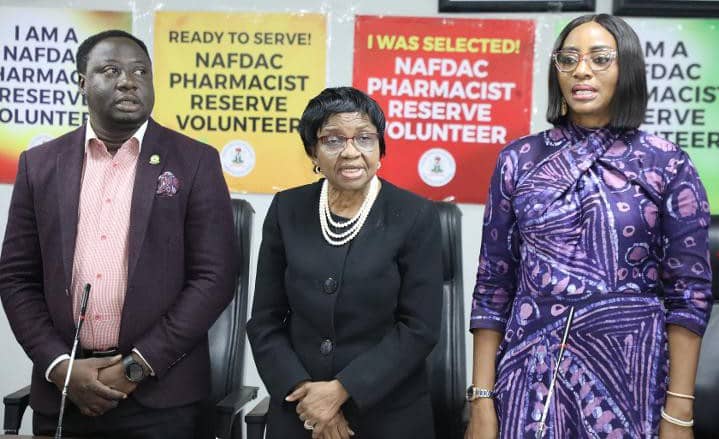
The National Agency for Food and Drug Administration and Control (NAFDAC) has inaugurated 600 pharmacists under its newly established Pharmacists Reserve Volunteer Programme (PRVP) as part of efforts to strengthen the fight against substandard and falsified medicines, unwholesome food and other products that pose risks to public health.
The NAFDAC Director-General, Prof. Mojisola Adeyeye, who inaugurated the programme and administered the oath of allegiance to the volunteers, said the initiative was designed to extend the agency’s regulatory reach to communities across the country.
The 600 pharmacists, drawn from the 36 states and the Federal Capital Territory and representing Nigeria’s six geopolitical zones, are already working in different fields but have volunteered to support NAFDAC’s regulatory activities when required.

Adeyeye said their selection followed a deliberate process based on merit, availability and equitable geographical representation.
“This programme is more than an internship or an attachment. It is an investment in you, and through you, in the regulatory future of this country,” she said.
According to her, the volunteers would be exposed to key areas of medicines regulation, including pharmacovigilance, compliance monitoring, quality assurance, data collection and public sensitisation on drug abuse.
In a statement issued by its media consultant, Sayo Akintola,She explained that the long-term objective was to establish a national reserve of trained pharmacists who could be mobilised at short notice during product recalls, suspected circulation of falsified medicines and public health emergencies, particularly in hard-to-reach communities.
The NAFDAC boss said her ambition was for every state to eventually have a standing pool of trained, vetted and mobilisable pharmacists working alongside the agency’s state offices.
This, she said, would ensure that NAFDAC’s regulatory presence was felt beyond its laboratories and ports of entry, extending to markets, community pharmacies, patent medicine stores and primary healthcare centres.
“Regulation that lives only in the capital cannot protect a nation of more than 200 million people. This programme is how we take regulation to the doorstep of the Nigerian people,” Adeyeye said.
The Director-General charged the volunteers to uphold integrity, discipline, confidentiality and professionalism, warning them against accepting inducements or succumbing to pressure in the course of their duties.
She stressed that the integrity of regulators was critical to public safety, noting that “the moment a regulator can be bought, the public loses its only protection.”
Adeyeye also warned the volunteers against disclosing confidential information obtained during inspections and investigations, urging them to treat such information as belonging to NAFDAC and the Nigerian people rather than for publication on social media.
She urged them to be available whenever called upon for assignments and to approach their responsibilities with a willingness to learn, ask questions, study regulatory guidelines and properly document their activities.
“You will enter markets, pharmacies and health facilities as ambassadors of NAFDAC and of the pharmacy profession. Conduct yourselves accordingly,” she said.
The DG said the programme would also provide significant professional benefits to the participants, including hands-on experience in pharmacovigilance reporting, laboratory awareness, risk communication and enforcement procedures.
She added that the volunteers would receive training and mentorship from experienced professionals, while their services would be formally documented through certification and letters of service that could strengthen their professional profiles before employers, licensing bodies and postgraduate institutions in Nigeria and abroad.
Adeyeye noted that the programme would also provide the pharmacists with an opportunity to build a national professional network and gain practical experience relevant to careers in the regulatory and pharmaceutical sectors.
She urged NAFDAC directors and state coordinators to take ownership of the volunteers by mentoring them and deploying them meaningfully to strengthen regulatory activities at the state level.
Addressing the volunteers, she said: “You carry today not just a certificate of enrolment, but a pledge to serve with integrity, to represent NAFDAC and your profession with honour, and to place the safety of the Nigerian public above every other consideration.”
The coordinator of the programme and Director, Narcotics and Controlled Substances (NCS), Dr. Momodu Omamegbe Rametu, said the initiative had evolved within weeks from a call for expression of interest into a national pool of 600 pharmacists.
Rametu described the PRVP as an organised reserve system designed to provide supplementary support and specific services during emergencies, while promoting greater citizen participation in regulatory activities, post-marketing surveillance and drug-demand reduction campaigns.

Also speaking, the Coordinator of the NAFDAC Training School, Dr. Tunde Sigbeku, said the programme would focus on equipping the volunteers with the knowledge and skills required to contribute effectively to the agency’s regulatory mandate.
He said the volunteers would receive training on post-market surveillance, pharmacovigilance, antimicrobial resistance prevention, proper use of medicines and veterinary medicines, inspection and enforcement, narcotics and controlled substances, as well as drug-abuse prevention.
Sigbeku added that the training would also equip the pharmacists to support surveillance, intelligence gathering and research.
He described volunteering as “more of a call to service than a title”, requiring devotion, responsibility and determination.
According to him, the programme represents the first time NAFDAC would have a nationwide reserve of trained pharmacists who could serve as “foot soldiers” to support the agency in its battle against fake, substandard and falsified products.